CSE 2026 Spring Departmental Demo Day

We're thrilled
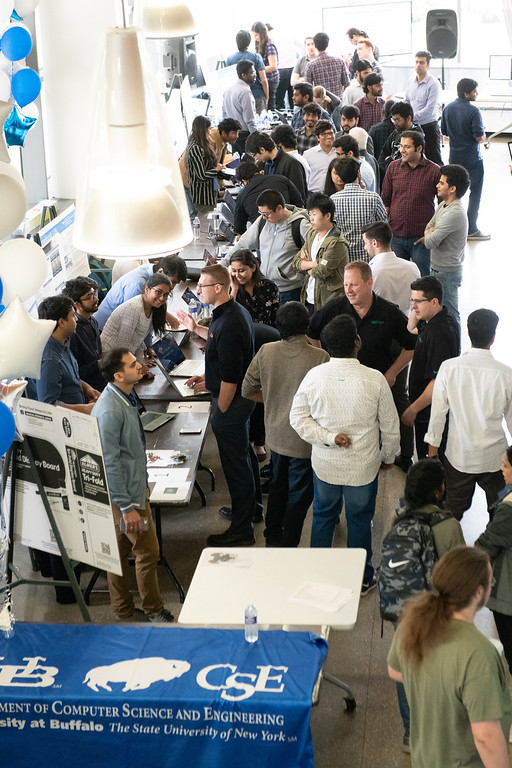
to invite you to the thirteenth bi-annual Comp. Sci. & Eng. Fall Demo Day. Student groups from several CSE capstone classes will be presenting the culmination of 3-months of effort, hard work, (metaphorical) blood, sweat (well... caffeine really), and tears (see above).
 Where:
 Davis Hall; 1st and 2nd Floor Atrium
 When:
When: Tuesday, May 5th, 2026
Schedule
Setup
Setup will start at Noon. Tables will be available for both sponsors (each sponsor will get a table) and demo participants (2 to a table). Easels will be available for participants. If you need power, please let us know! If you have any other special requests, please contact ahunt@buffalo.edu to let me know, and we will do our best to accomodate you. There are two hours reserved for setup - you can come at any time during that period to get organized, but please make sure you leave yourself enough time to be ready to go by 2PM, to give you the chance to network.
Networking
Before we open the atrium to students and the public, we’ll have some time reserved for the participants to come and chat with the sponsors and the judges. Pizza will be there as well (A big thank you to our sponsors!), so that the participants and sponsors can have a chance to eat before demos begin!
Judging
During the demo, judges will circulate to the participants demo stations, and they will be rating each project on a specific set of criteria. Judges, expect to spend approximately five minutes with each team, in order to give you time to see them all. You will be assigned a set of projects to view specifically, but you can feel free to talk to more teams as time permits! Teams, keep this in mind and keep your presentations crisp and to the point!
Prizes
There will be prizes for the top teams selected by the judges. They will be announced in the atrium, and there will be a quick photo op for each winner. Good luck to everyone, and I can’t wait to see you all there!
Winners
1st Place (Tie) - Traveller Tracker
1st Place (Tie) - Building a VMAT Dose Prediction Engine
2nd Place - Find a Mechanic
3rd Place - Friday Night at the Disco Tomb
Acknowledgements
Sponsors


Judges
- Chris Miller
- Nicholas MacRae
- Sai Roshan Ayyalasomayajula
- Jesse Hartloff
- John Ebel
- John Leone
- Karlene Kardysauskas
- Brianna Swartz
- Kevin Cleary
- Nick Minor
- Jim Brandt
- Nitin Kulkarni
- Mike Canzoneri
- Naresh Devulapally
- Andrew Balys
- Alina Vereschaka
- Anurag Mahajan
- Shradda Shekhar
- Olga Wodo
- Marina Blanton
- Carl Alphonse
- Jessica Grogan
- Mason Lary
- Shawn Zimmerman
- Dave Doermann
- Param Sagparia
- Asif Imran
- Justin Woods
- Piyush Gulhane
- Rishab Shylendra
- Pavithran Gnanasekaran
- Matthew Hertz
- Sandip Leihal
Presented Projects
(CSE 474)
(Club (Make Open Source))
- Flappy Bird VR
-
Flappy Bird VR is a in progress flappy bird game built in Unreal Engine for the Meta VR Headset.
(CSE 302/303/402)
- Encrypted Storage
-
A multi-device encrypted storage system where the decryption key is split across user-owned devices, so no single device holds the full key.
- Find a Mechanic
-
A web-based marketplace that connects customers with local service providers for scheduling, invoicing, and job management, built to give small businesses the tools of a large enterprise, without the cost or complexity.
- Unfold Studio
-
An interactive storytelling platform that teaches computational literacy through creative writing, empowering students, teachers, and anonymous users to explore identity, and culture while learning to code.
- Scalable LED Video Wall
-
A scalable LED video wall constructed from a series of LED matrices and microcontrollers, capable of rendering images, videos, live streams, webpages, and other configurable elements.
- Pirouette
-
This project is the world's first functional choreographic programming language that is provably deadlock free. The compiler is written in OCaml by a team of undergraduates and has been in development since 2023. It is used for writing distributed systems and takes advantage of higher order logic to make the language easier to reason about than traditional methods.
- AI Energy Optimization
-
AI Energy Optimization's project serves to be one step in the goal for optimizing the energy being consumed during the training of LLMs. The Application allows for users to select AI models and how their configured during training, so that they can view a report card of the energy being consumed during the training process.
- UBHacking CMS
-
The UBHacking CMS platform adds tools for the organizers of UB's Hackathon to efficiently manage registrations, check-ins, communications, team generation, user roles, and logistics without requiring technical expertise. This platform also adds to the experience of attending the hackathon by rewarding points for participating in events, which can then be redeemed to earn prizes throughout the events.
(CSE 370: UI/UX)
- Goat Kids
-
A social media web application with the objective to be the premier community driven platform. This app allows users to bond over each other's opinions through various user interactions such as posts, ratings, rankings, polls, and media.
- 9Syner9y
-
To create close-knit communities for people through specific groups\ Project Description: The app will have the ability for a user to join different groups based on a hobby or interest. When they navigate to one of these groups, they will be taken to a feed of posts by other members of the group. The application will be focused on helping people make connections in smaller, close-knit circles of people. It will have lots of customization to allow the user to make their page look how they want. There will be an interactive mascot in the form of a wizard-duck, that will have different reactions based on how the user navigates through the website
- REAL
-
REAL is a non-traditional dating application that redefines how people form connections by prioritizing authenticity over curated perfection. Inspired by elements of BeReal and Hinge, the platform blends real-time, candid content with meaningful relationship-building features. Users share unfiltered photos and short videos that capture their everyday lives, allowing others to discover personalities through genuine moments rather than polished profiles. The app also introduces a customizable discovery feed, enabling users to explore connections based on interests, daily routines, or storytelling formats. With integrated profile verification badges and a focus on safety and transparency, it also creates a more trustworthy and engaging environment where users can build deeper, more realistic relationships over time.
- UBEES / BOOKCLUB
-
A social media platform tailored for book lovers including unique aspects which make it different from other media on the market today.
- Project name : Personally , Group name : Merge Conflict
-
Personally is a journaling and emotional wellness website designed to help users reflect, connect, and feel supported in a more personal way. The platform allows users to create journal posts with topic tags, daily prompts, and emoji selections, making each entry more expressive and meaningful. To help users better understand their emotional patterns, Personally also includes a monthly mood summary feature with a visual chart that tracks mood trends over time. Beyond journaling, the website encourages community and support. Users can join health and safety groups, follow one another, and interact through private posts shared with friends or public posts shared with all users. On other users’ profiles, supportive sticky notes can be added to leave kind messages and encouragement. Personally also prioritizes user safety through its crisis support features. When a user types concerning keywords, the website displays a helpful popup with mental health resources, support websites, and important phone numbers, making it easier to seek help when needed.
(CSE 4/555 Intro to Patern Recognition)
- Emotion-Aware Face Modeling with EMOCA
-
EMOCA focuses on emotional 3D face reconstruction, and its page now points users toward INFERNO for stronger face reconstruction tooling. Your team can build a project on emotion-aware reconstruction, expression clustering in FLAME space, or expression consistency across a video.
(CSE 420 : Game Design)
- RPG Game For CSE420
-
An RPG dungeon fighting game where you spawn in a randomly generated dungeon, defeat the enemies to progress through the dungeon and fight the boss at the end of the dungeon! The project includes spells, a health and mana system, an inventory system, a quest system, a minimap, tutorials, and main menu with adjustable settings. This project was worked on Jonathan Wu, Lichang Zhang, and Andrew Lin-Wu throughout the semester for the CSE420 class.
- Dice Roll On
-
A game based on stat builders and dice rolling. The focus is on trying to build up a character card to make your dice rolling as strong as possible.
- Escape Lurkwood
-
A survival horror game for PC where the player is tasked with escaping from a monster in the "Lurkwood" Library (loosely based on UB's Lockwood Library). The game includes multiple floors the player must traverse, along with items they must equip along the way, in order to successfully escape.
- Necrosis
-
A single player game where the player has to survive endless hoards of undead. The player uses spells and upgrades to make themselves stronger in order to survive as long as they can and beat personal high scores.
- Punch Shot Golf
-
Punch Shot Golf is a golf platformer game developed using Unreal Engine 5 for the course CSE420
- Dungeon & Live
-
This game is like vampire survivor or megabonk but with a gambling twist where when you level up, you roll a d20 dice like in DND and gain buffs or gain nerfs to yourself. Just like in DND there is an end game, for this demo the end game is getting to level 10 and beating a boss just like in DND.
- RadioHeads
-
Static is a single-player psychological horror game made in Unreal Engine 5. The player wakes up in a strange building with no memory, guided only by a handheld radio. What starts as simple instructions slowly becomes more unsettling, forcing the player to question who they can trust. The game features exploration, puzzles, unique enemies, and meaningful choices that shape the story and environment.
- Buggin' Around
-
After a boot accident that destroys your wings, you crash land in a town of bugs called The Stump. Your goal is to collect items to fix your wings from the different inhabitants of The Stump by completing their quests/tasks.
- Mindless-Sector
-
An unreal engine 5.7 project/game where you fight off zombies and survive.
- Let ME Out
-
Let Me Out is a First Person Horror game, where you play as a character that has been kidnapped by an unknown entity. You wake up in an abandoned hospital and try to maneuver you way through, and escape. However, the hospital isn't a normal one, as their are different paranormal beings roaming the facility. As you progress through you realize there have been others before you; but they are no longer with us. Fortunately, they left some clues around to help you the next victims trapped (you).
- Friday Night at the Disco Tomb
-
A mix of a dungeon crawler and a rhythm game.
- RoboGoose the Game
-
RoboGoose is a fast paced action game built in Unreal Engine, where you play as a time traveling goose inspired by The Terminator, sent back to stop the creation of the world’s first nuclear loaf. Armed with high powered weapons and robotic abilities, players tear through environments filled with physics driven chaos and enemies that ragdoll. Designed with speedrunning in mind, RoboGoose challenges players to master movement, optimize routes, and complete levels as efficiently as possible.
(CSE 442: Software Engineering)
- All In or Nothing
-
All In or Nothing creates a fun and accessible online space where users can enjoy casino style games, digital currency, and collect or trade virtual items. All In or Nothing blends gambling, collecting and social life into one exciting experience that users can enjoy anytime, anywhere.
- FixFlow
-
The Bug Triage & Prioritization System (AI-Assisted) is a full-stack web application that facilitates developers to effectively organize and prioritize software bugs. Conventional bug tracking systems are primarily concerned with the collection and listing of bugs but they usually do not have any intelligent support in deciding on the bugs to be resolved first. The proposed project seeks to address that gap and integrate the regular bug tracking with the AI-enhanced analysis. The system enables users to file bug reports, monitor their status, assign ownership, and display bugs according to priority and not just in a chronological order. It also adds some important reliability impact and expected resolution time to better represent the reality of software running in the field. AI is implemented as a complementary feature to boost productivity and not to substitute human decision-making. Auto bug summarization, proposed severity and smart prioritization are some of the features that have been used to save time on the part of the developers that are analyzing bug reports. Moreover, the system will be able to produce the explanations of prioritization choices and emphasize the key, high-impact problems. In general, the project provides a realistic and scalable solution to enhance the efficiency of bug management, lighten the cognitive load of developers and facilitate the development of better decisions in the contemporary software development context.
- Livestock Epidemic Tracker
-
We are all-in-one platform designed to monitor the spread of livestock diseases such as swine flu, bluetongue, and more. By aggregating fragmented data from sources like the CDC, WHO, and user reports, the platform enables farmers to easily visualize where outbreaks are occurring across the United States.
(CSE 546: Reinforcement Learning)
- Caddisfly
-
A Reinforcement Learning based dynamic digital tutor for K-12 students with ADHD behavior traits
- Project 10
-
In this project we are building a movie recommendation system using reinforcement learning and multi agent reinforcement learning. Instead of treating recommendation as a pure rating prediction problem, we model movie browsing as a sequential decision process where agents interact with A movie catalog and gradually learn their own behavior.
- Multi-agent RLAIF and User Simulations for Goal-Oriented Dialogue using PPO/ Team -12
-
We built an automated pipeline to train a flight booking AI using Reinforcement Learning from AI Feedback (RLAIF). In this setup, our fine-tuned Mistral-7B agent practices negotiating with a simulated customer, generating multiple potential conversational pathways for every scenario. A strict AI judge then evaluates these transcripts, calculating a precise reward score by checking for successful bookings and heavily penalizing hallucinations. Finally, the pipeline uses a Best reinforcement learning strategy to compare these reward scores, saving only the most successful interaction to continuously improve the model's baseline behavior.
(CSE 555 Pattern recognition)
(CSE 555: Introduction to Pattern Recognition )
- VAE vs Diffusion on the Same Dataset
-
Use the deep generative models’ site that includes VAE and diffusion to build a controlled comparison on the small CIFAR-10 dataset provided. Ask which model reconstructs best, which samples best, and which is easiest to train. That makes a very clean course project paper.
(CSE 573)
(CSE 587: Data Intensive Computing)
- Group 11
-
Predicting NYC Taxi Trip Duration using Big Data Analytics
- Flight Delay Prediction and Analysis
-
This project focuses on analyzing and predicting flight delays using a dataset containing various flight attributes such as departure times, arrival times, and other relevant factors. The dataset was first cleaned and preprocessed to ensure accuracy and usability. We then conducted exploratory data analysis to understand patterns, distributions, and relationships within the data. Building on these insights, we applied machine learning techniques to develop models that predict flight delays. This allowed us to better understand key factors influencing delays and evaluate their impact on both airlines and passengers.
- Spotify_Music_Analysis
-
PySpark-based Spotify analysis project, covering regression, classification, clustering, and six data analysis objectives using HDFS data.
- 87thQuants
-
This project analyzes S&P 500 daily stock data (2014–2017) as an end-to-end big data workflow: raw data on HDFS, cleaning and EDA in Python, then PySpark ML on the cleaned dataset—Random Forest for next-day up/down direction, gradient-boosted trees for daily return regression, and K‑means to group stocks—with cross-validated hyperparameter tuning and charts to interpret results.
- Machine Learning-Based Risk Prediction and Analysis of Diabetes
-
Diabetes is a common chronic disease in the United States and creates a major burden for individuals and the healthcare system. This project analyzes the BRFSS 2015 dataset to explore the relationship between health indicators and diabetes risk. Using data analysis and machine learning, we aim to identify important risk factors and build models to predict diabetes or prediabetes based on survey responses.
- Predicting NYC Yellow Taxi Trip Duration and Detecting Fare Anomalies Using Big Data Analytics
-
Using big data analytics to predict NYC yellow taxi trip duration and fare anomalies
- TreeMap: Predicting Forest Cover from the Ground Up
-
A big data approach to mapping dominant tree species across patches of the Roosevelt National Forest using only low-cost cartographic variables (elevation, slope, soil, hydrology), built on a Hadoop/HDFS pipeline with classification, clustering, and regression analyses.
- Customer Purchase Behavior and Sales Pattern Analysis
-
This project analyzes a large-scale online retail transaction dataset to understand customer purchase behavior, sales concentration, transaction value patterns, product demand, and time-based purchasing trends.
- Predicting Car Sales Prices with PySpark/Group 21
-
Semester project. We performed exploratory data analysis, linear regression, and gradient boosted decision trees based on a Kaggle dataset to obtain regression models of car selling price and Manheim Market Report.
- Prediction of Customer Churn in E-commerce Using Shopper Behavior and Lifestyle Information
-
It is a project that uses customer data to identify which users are likely to stop purchasing from an online platform. It analyses shopping behaviour (like purchase frequency and browsing patterns) along with lifestyle factors (such as demographics and interests).
- Exploratory Analysis of MLB Player Performance and Salary
-
The objective of this project is to build an end-to-end big data pipeline to analyze Major League Baseball (MLB) player performances, their compensation, and predict their future offensive output. This problem falls under the sports analytics and finance domain. In professional sports, teams spend hundreds of millions of dollars building rosters. Understanding whether a player's current on-field statistics, age, and physical traits can accurately forecast their next-season performance is critical for building a cost-effective, winning team. The primary stakeholders who would benefit from this analysis include MLB team general managers (for contract negotiations and predicting future decline/growth), sports scouts, and fantasy baseball enthusiasts seeking data-driven insights for drafts.
(CSE 611: Master's Capstone Project)
- SK Interns
-
Developed Job board feature for the Safety Knights application.
- Floe Field Data Management Platform
-
Field teams often rely on disconnected tools. This leads to fragmented information, inefficient coordination, and limited visibility into field operations. Our project addresses this problem by building a centralized field data management platform for Floe that integrates accounts, orders, devices, media uploads, notes, reports, reminders, role-based access control, and SMS-enabled communication workflows. The platform provides a single source of truth that helps teams organize field data, improve communication, and make faster operational decisions.
- AI Realestate/Offerwell
-
Use AI to help users find properties easier compared to the way people are used to by enter hard filters.
- Look The Part
-
Look the Part® is a fashion discovery service that aims to combine entertainment and fashion by making it easier to bring on-screen style into everyday life. Founded in 2019 by Lisa Cronin, Look the Part published its first social media inspired mobile application in 2020. The app was built from scratch by UB Graduate Students (CSE 611) based on early designs and a prototype by Look the Part’s founder. As of January 2026, in spite of subsequent updates, the application's management platform, Creation Studio, lacked many features desired by its founder, and the platform possessed critical vulnerabilities that jeopardized the security of the application and its data. Therefore, this semester's Look the Part team aimed to help the application's management interface keep up with its growing user base, addressing key security issues, improving its analysis of user data, streamlining the blog post workflow, automating the completion of forms and image watermarking, and enhancing its search functionality.
- AI-Powered Data Extraction System
-
- Jay Niketan Pathare
- Teja Krishna Sai Uppugunduri
- Anutej Kardele
- Sejal Sanjay Baser
- Pranav Chandrahas Kundaikar
An automated data extraction pipeline that replicates manual data entry processes using intelligent inference techniques. The system reduces processing time by approximately 33% while achieving up to 80% accuracy, supported by a human-in-the-loop review process to identify and correct anomalies. The pipeline integrates multiple data sources, including API retrieval (when available), dynamic web scraping of document-specific webpages (when accessible), and LLM-based parsing of both digital and scanned PDFs. These approaches are combined to generate a unified, high-level structured output.
(CSE 635: NLP & Text Mining)
- Multimodal AAC chatbot
-
Multimodal AAC Chatbot is an AI-driven assistive communication system that processes multimodal inputs (text, and optionally images/audio) to generate context-aware responses for users with speech or language impairments. It integrates LLM-based reasoning to enhance accessibility, enabling more natural and efficient communication.
(CSE 676: Deep Learning)
- Cardiorespiratory Sound AI
-
Cardiorespiratory Sound AI is a deep learning pipeline that automatically analyzes breath and heart sounds to detect abnormalities and diagnose diseases. The system processes raw audio recordings from patients, extracts ~180 acoustic features, and uses a multi-task neural network to simultaneously classify adventitious sounds (Normal, Crackle, Wheeze) and 8 respiratory diseases. It's trained on multiple clinical datasets including ICBHI 2017, Zenodo, and PhysioNet, with a strict patient-grouped evaluation strategy to ensure reliable, real-world results.
- E. coli and Wastewater peptide sequencing using de novo tools
-
Peptide and protein identification from tandem mass spectrometry (MS/MS) data is a central problem in proteomics. Database searching is a widely popular approach to solve this problem by matching observed spectra against a set of peptide sequences contained in a reference protein database. This approach is good for samples for which there is sufficient representation in the reference database. However, for complex biological samples, there may be proteins of unknown or poorly characterized or underrepresented species. This is particularly critical for wastewater samples, as wastewater may contain proteins from microorganisms, human sources, and environmental sources, many of which may not be well represented in reference databases. Therefore, a de novo approach to sequencing may be helpful, as it can predict peptide sequences based on spectra without relying on a reference database.
- Temporal Financial Risk Modelling
-
Employing Time series forecasting models on Yahoo Finance Dataset for comprehensive financial analysis and prediction
- Group 5
-
Peptide and Protein Sequencing by Multinomial Diffusion Model
- Beyond Text: Speaker Credibility for Fake News Detection
-
This project studies fake news detection by comparing the predictive value of statement text and speaker credibility history. Using LIAR and BuzzFeed, it evaluates text-only, metadata-only, and fusion models, showing that speaker credibility is a dominant signal on LIAR while also creating robustness challenges under domain shift.
- ticketbots
-
Service Desk Ticket Classification Using Deep Learning
- Brain Tumour Segmentation in MRI Images Using Deep Learning
-
Brain tumors are among the most life-threatening conditions in modern medicine, and their early and accurate detection is critical for effective treatment planning. Magnetic Resonance Imaging (MRI) is the primary non-invasive technique used for brain tumor diagnosis. However, manual segmentation of tumor regions from MRI scans is time-consuming, labour-intensive, and subject to variability between clinicians. This project proposes an automated deep learning approach to brain tumor segmentation using U-Net, a convolutional neural network architecture widely adopted as the benchmark for medical image segmentation tasks. The model will be trained and evaluated on a publicly available MRI dataset, with the goal of accurately identifying and delineating tumor regions to assist radiologists in clinical settings
- Dream Project II
-
CSE 676 Course Project. Fighting Shortcut Learning in Waterbirds: Loss-Guided and Saliency-Guided Robustness Attempts
- CodeSense AI coding agent
-
CodeSense is an AI-driven code analysis and developer assistance platform that combines static analysis with LLM-based reasoning to understand code context, detect potential bugs, and suggest improvements. It processes codebases to identify patterns, optimize performance, and assist developers in debugging and decision-making, improving development efficiency and code quality.
- Dream Project
-
This project investigates how to improve model robustness on the Waterbirds dataset by reducing reliance on spurious background correlations and encouraging learning of core semantic features. It combines pretrained representations (ViT, DINOv2) with a novel gradient-based core-aligned regularization technique to improve worst-group performance and interpretability.
(CSE 711)
- Radio-based Soil Bulk Density Sensing
-
We try to measuring soil bulk density independent of the soil moisture using radio-based method.
- RF Based Soil Moisture Sensing
-
Using a radar and aluminum plate to measure soil moisture of a houseplant. I also created an application with ML to classify plant health based on readings.
- WiFi CSI Gesture Quality Recognition
-
Wireless sensing has been widely studied for its applications in gesture recognition in recent years. Research has focused on how human movement can be detected through its impact on wireless signals in order to classify the movement into specific gestures. This project aims to expand beyond classification into the field of assessment. Certain applications benefit from information beyond classification, by instead learning about the gesture being performed. Specifically, in the field of fitness including the gym, sports, physical therapy, and other forms of exercise, the importance of maintaining form is evident. Focusing on the gym, maintaining form while you work out leads to increased effectiveness of the workout while also helping to prevent injury. Existing approaches to assist in maintaining form including vision based systems and wearable devices, can be expensive and inconvenient. To address this, we built a system to assess the quality of form while performing bicep curls through the use of wireless signals. Our system derives quality assessment through the use of WiFi CSI signals. The system will rely on two ESP32 microcon- trollers to collect CSI data, which will be processed into a time-frequency spectrogram representation, from which motion related features will be extracted and used to evaluate the quality of the curl being performed. The goal of this work is to determine if the pipeline can output a quality assessment of the curl. The final output of the pipeline will include a quality score for the curl, along with potential feedback for improvement of the gesture. Successful results will demonstrate the potential for assessing gesture quality with CSI data, showing advancement into the field of gesture assessment is possible.
(CSE 799 Supervised Research)
- Modeling Lab Panels with VAEs: Reconstruction, and Synthetic Anomaly Detection
-
We build variational autoencoder models on real-world electronic health record laboratory data across three routine panels: Complete Blood Count (CBC), Comprehensive Metabolic Panel (CMP), and a Hepatic Function Panel (HFP). The models learn a low-dimensional latent representation of jointly observed analytes and handle incomplete panels via masked reconstruction loss and, where explored, learned embeddings for missing inputs. We assess how well each analyte can be predicted from the others (e.g. leave-one-feature-out / masking analyses). For anomaly detection, we inject controlled synthetic perturbations into analytes the model already predicts reliably, then use reconstruction error relative to a data-driven threshold to test whether the model flags these synthetic abnormalities. Together, this work evaluates whether generative models can encode “normal” multivariate lab structure and support principled, testable anomaly screening across panels.
(CSE 799: Supervised Research)
- Phonix
-
Automating Speech Sound Disorder Related Therapies and Data Tracking for Speech-Language Pathologists
- Next-Gen Autonomous Vehicle Scenario Generation using LLMs
-
Build a LLM based pipeline for adversarial scenario generation for autonomous vehicle testing and simulation in CARLA
- PI-WHISPER on Edge: Real-Time Deployment & System Design on NVIDIA Jetson
-
PI-Whisper is an ultra-low latency Automatic Speech Recognition (ASR) system extending OpenAI's Whisper for seamless edge deployment on devices like NVIDIA Jetson. To achieve high accuracy and real-time adaptability, the system utilizes specialized CNNs to predict a user's Age, Gender, and Accent on the fly, dynamically pooling tailored Low-Rank Adaptation (LoRA) profiles via a weighted PEFT adapter. Operating on a distributed architecture, PI-Whisper guarantees optimal performance in resource-constrained environments by combining strict task-scoped CUDA memory controls with zero-copy MJPEG buffering for ultra-low streaming latency.
- SPICA: Scalable and Personalized Conversational Agent Framework for AAC Users
-
People who rely on Augmentative and Alternative Communication devices to speak face a fundamental problem: existing AI systems can generate fluent responses, but those responses don't sound like them. They borrow a voice rather than preserve one. SPICA addresses this by introducing an agentic orchestration layer that dynamically indexes a user's personal data, including journals, call logs, and social posts, into a structured knowledge base, and retrieves the most relevant context at conversation time to generate responses that reflect the user's actual identity, tone, and preferences. No model retraining required. We validated the system across 205 synthetic AAC user profiles and a live study with a real AAC user, achieving 22% improvement in factual groundedness and 30% reduction in hallucination over baseline LLMs, while keeping response latency under 12 seconds, within practical AAC usability thresholds. The result is a system that makes communication faster, more authentic, and more personal for users who have historically had to settle for generic.
(cse546 demo day)
- Offline Reinforcement Learning for Adaptive FEC Control in WebRTC
-
Today's WebRTC stack (Google Meet, Discord, Microsoft Teams, Zoom) picks Forward Error Correction (FEC) redundancy with a hand-tuned threshold rule that saturates on cellular links — wasting bandwidth when the link is good and reacting too slowly when it isn't. We train an offline reinforcement-learning agent (CQL, BCQ, DQN) purely from logs of the existing rule-based controller, following the recipe Mowgli (NSDI'25) used for sender-side rate control. The result: DQN beats the rule-based controller by 23× reward across three real public LTE/3G traces (Verizon, T-Mobile, Norway 3G), with seed-level statistical significance p < 10⁻⁴. We validate end-to-end on a real H.264 RTP video stream traversing a Mahimahi- shaped link with our own RFC 5109-compatible XOR FEC, where DQN delivers higher receiver-side PSNR using only 0.6–5.5% bandwidth overhead vs. the rule's 41–46%. We additionally provide stratified out-of-distribution Q-value analysis that mechanistically explains a counterintuitive finding: CQL anchors to the rule-based attractor across a four-decade α-sweep — a rare published counterexample to the "always pick CQL" folklore in offline RL.
(CSE587)
- Customer Churn Prediction in E-Commerce Using Transactional Behavioral Data
-
Churn is a metric that defines user retention in e-commerce businesses. In this report, we are using the Online Retail dataset by UCI to predict the user churn using machine learning concepts and EDA. Since the churn is not mentioned explicitly, we defined it as customer inactivity over a prolonged period of time. The study involves cleaning and preprocessing the data before it is fed to the machine learning models. We also did exploratory data analysis (EDA) to get the basic trends in the data. Post that, three Machine learning models were used: binary classification to predict whether a customer will churn, linear regression to predict the time to churn, and clustering to segment customers on the basis of purchasing behavior.
(CSE587 - Data Intensive Computing)
(Independent Study / Research)
- Vibe Design Assistant
-
A new Vibe Coding paradigm that supports absolute newcomers in designing UX friendly products
- RADI3N: Training-Free GeometRic ImAge EDiting vIa Parametric 3D CoNtrol
-
- Abdul Wasi
- Akhil V S S Gorugantu
- Mahesh Shivaji Bhosale
- Sauradip Nag
- Anjan Dutta
- Junsong Yuan
- David Doermann
Recent diffusion-based methods have substantially advanced image editing, yet controlled geometric manipulation remains challenging. In particular, existing approaches struggle to provide parametric control over object transformations (e.g., translation, rotation, and scaling) and often fail to model lighting and shadow consistency, resulting in unrealistic outputs in geometry-intensive edits such as rotations or perspective changes. To address these limitations, we introduce RADI3N, a training-free framework that enables part-aware object manipulation with parametric 3D geometric control. Our approach incorporates a novel CS-ARAP deformation module to produce smoother and structurally consistent deformations under complex part-level edits. In addition, we mitigate appearance inconsistencies by introducing a diffusion-based appearance injection mechanism that transfers lighting and shadow cues to the edited geometry. Extensive experiments demonstrate that RADI3N achieves state-of-the-art performance in fidelity, viewpoint consistency, and controllability.
- PathDiff: Histopathology Image Synthesis with Unpaired Text and Mask Conditions
-
- Mahesh Bhosale
- Abdul Wasi
- Yuanhao Zhai
- Yunjie Tian
- Samuel Border
- Nan Xi
- Pinaki Sarder
- Junsong Yuan
- David Doermann
- Xuan Gong
Diffusion-based generative models have shown promise in synthesizing histopathology images to address data scarcity caused by privacy constraints. Diagnostic text reports provide high-level semantic descriptions, and masks offer fine-grained spatial structures essential for representing distinct morphological regions. However, public datasets lack paired text and mask data for the same histopathological images, limiting their joint use in image generation. This constraint restricts the ability to fully exploit the benefits of combining both modalities for enhanced control over semantics and spatial details. To overcome this, we propose PathDiff, a diffusion framework that effectively learns from unpaired mask-text data by integrating both modalities into a unified conditioning space. PathDiff allows precise control over structural and contextual features, generating high-quality, semantically accurate images. PathDiff also improves image fidelity, text-image alignment, and faithfulness, enhancing data augmentation for downstream tasks like nuclei segmentation and classification. Extensive experiments demonstrate its superiority over existing methods.
- Agentic Instagram Scraper
-
Instagram post comments scraper, with self-correcting capabilities using a custom-built AI agent.
- Testing Code-switching classification on Hinglish
-
We are accessing the validity of utilizing a NN classifier to differentiate/identify instances of code-switching within Hinglish audio. If successful we then attempt to utilize the classifier to integrate with Single language ASR models
- Graph Laplacian Merging
-
In data-free model merging, multiple task experts trained from a shared base model are combined into a single merged model without access to the original training data. This is valuable for reducing storage, privacy, and retraining overhead while preserving task performance. We propose a graph Laplacian-based approach that leverages learned task relationships to regularize the merge weights, encouraging similar tasks to receive similar contributions and thereby reducing destructive interference during merging
- Building a VMAT Dose Prediction Engine
-
My research group at Roswell Park built an end-to-end VMAT dose prediction engine to serve as a replacement for the traditional clinical treatment planning system (TPS). Eclipse, the currently used TPS, is very accurate has slow computation times. By leveraging advances in physics informed neural networks and domain expertise, we built a full dose prediction pipeline that can serve as a faster, and just as accurate, TPS.
- Draupnir
-
Draupnir is a datalog engine that that draws on group-/ring-theoretic provenance models to scale to large datalog workloads on commodity hardware.
- Ambiguity in LLM-powered semantic operators
-
We study the variance and accuracy of LLM-powered semantic operators under ambiguous or unambiguous natural language queries, analyzing their reasoning and output consistency. We use LOTUS as our framework and construct a SQL-based gold standard dataset using fuzzy matching on data from IMDb and JOB datasets. We also create a corresponding document-based dataset from processed HTML pages to compare results across structured and unstructured settings. Our goal is to evaluate the reliability and usefulness of these systems in the presence of ambiguity.
- Science of Reading Teacher Training Simulation
-
An immersive VR teacher training platform that enables educators to practice structured literacy instruction in a realistic classroom environment. Built with Unity and Meta Quest, the simulation features an AI-powered virtual student that responds authentically to teaching strategies across all five Science of Reading pillars: phonemic awareness, phonics, fluency, vocabulary and comprehension. The system leverages OpenAI's GPT models with Retrieval-Augmented Generation (RAG) to deliver contextually appropriate student responses grounded in evidence-based reading science. A multi-agent architecture governs student behavior through three specialized AI agents controlling verbal responses, emotional states and physical actions. To ensure accuracy in early literacy instruction the platform integrates custom accent-aware phoneme recognition that parses isolated phonemes across diverse accents. This simulation provides educators with safe, repeatable opportunities to rehearse instructional techniques and refine their teaching practice before working with real students.
- Differential Privacy for WiFi Sensing Systems
-
WiFi sensing is a technology that uses WiFi signals already emitted by wireless devices for the purpose of movement detection. These systems enable applications such as smart home automation, health monitoring, security, and even localization. However, these systems also create significant privacy concerns as channel information can reveal and track user locations without their consent. This project explores the application of differential privacy to WiFi sensing systems. Differential privacy introduces carefully created noise into the mechanisms that expose channel state information to clients utilizing the system. This noise is tuned to ensure that the presence or absence of any single individual yields near indistinguishable results on the output returned. The project aims to provide quantifiable privacy guarantees against unauthorized tracking and inference while still preserving the utility of sensing applications.
- HandCraftedCNN
-
This project is about building and parallelizing a convolutional neural network from scratch. Instead of using third party libraries, I'm using CUDA to build a CNN. I created a sequential solution using C++ as well to show strong scaling. I have built a testing suite to compare my solution to other popular third-party libraries like Pytorch.
- Olli Revival
-
The Olli Revival project at the CAVAS lab focuses on restoring an autonomous shuttle to full operational capacity through comprehensive firmware and software development. The core initiative centers on engineering a reliable drive by wire system and a modern ROS 2 driver stack utilizing C++, Python, and MATLAB Simulink. Essential tasks include developing low level vehicle control logic, managing CAN bus messaging, and integrating critical navigation sensors such as GNSS and IMU components into the updated architecture. By resolving system errors and modernizing legacy components, the project aims to establish a highly functional and safety critical autonomous research platform.
- Non verbal audio driven infant expression synthesis
-
This work presents a diffusion-based framework that generates 3D infant facial motion from non-verbal vocalizations such as crying, laughing, and babbling using the INFACE infant facial representation. By training on a curated benchmark of 707 infant clips with audio–visual synchronization losses, the method improves audio–motion alignment over FLAME-based and phoneme-based baselines and supports reproducible infant-specific facial animation research
- WildlifeWatch
-
Detection and Identification of Wildlife Species in videos and Live streams
- Organizational charts
-
An AI-powered organizational chart generator that automatically creates and visualizes company hierarchy structures.
- myVictor
-
MyVictor is a Graph RAG system that turns UB CSE website data into a structured knowledge graph. Enables more accurate, explainable answers by understanding relationships between faculty, courses, labs, and programs. It helps answer questions regarding who teaches what, which labs work in specific research areas, and what courses or requirements are needed for programs.
- Advanced Portable Trancriber
-
This device utilizes state of the art Natural Language Processing to transcribe audio input. This device leverages an on-device, and private model that can be used locally and does not rely on a cloud to improve the speed and overall privacy of the data flow. This implementation is built around a Raspberry Pi and an LCD Screen to output the real-time transcription data.
- Traveler Tracker
-
Currently an Surface Mount Technology service company uses a system of tracking information of orders called "Travelers". These travelers are pieces of paper that track which operators have done certain steps of the process of the surface mount devices. This system sets the foundation for the Traveler Tracker service. This service uses QR codes that are generated during the recieving process of orders, which are stickered to the travelers, to track entire orders moving through the building. This service also requires users to scan their, already company supplied, RFID Cards to scan into the seprate scan stations to track the operator history on orders.
- Advisor: Shamsad Parvin/Dheeraj Roy
-
Using MERFISH spatial transcriptomics, we profiled single-cell gene expression in the mouse anterior thalamic nucleus (ATN) across four learning timepoints in young and aged mice. We identified baseline transcriptomic differences between young and aged ATN, characterized learning-associated gene expression patterns, and discovered candidate genes whose learning-induced transcriptional responses are selectively disrupted by aging, providing molecular targets for understanding age-related cognitive decline.
- LayerLens
-
Language models are black boxes. You put text in, an answer comes out, and nothing in between is visible. LayerLens opens that box. It intercepts a model's internal state at every layer and tracks how confidently it predicts each word as processing deepens. Words the model was about to get right but did not are called late-drop tokens. LayerLens flags these in real time. Across 32,000 words and two model architectures, these flagged words turn out to be wrong 86% of the time. That makes the trajectory shape a better uncertainty signal than the model's own confidence score. The same analysis reveals something else. Simple words like "the" and "and" are resolved by the middle layers. The compute spent on them after that point is wasted. LayerLens measures exactly how much. Both findings are interactive. Type any sentence, watch the model think layer by layer, and see exactly where it hesitates.
- CLIP-Guided Discriminative Region Scoring for Fine-Grained Classification
-
This project aims to explore better CLIP-guided scoring methods to evaluate the discriminative information contained in local candidate regions generated by either SAM masks or random crops, thereby helping distinguish visually similar categories and improve fine-grained classification performance.
- HW_Gen
-
This project is about generating full handwritten documents in a target writer’s style from a few reference handwriting samples, while improving readability, layout, and support for difficult characters like numbers, punctuation, and acronyms.
(CSE450/453)
- RoboGoose 453
-
RoboGoose is a remote controlled robotic Canada goose built for our CSE senior design capstone, designed to roam campus showcase events. Inside the plush, an Arduino Mega coordinates a tank drive base using REV NEO motors and Spark MAX controllers over a CAN bus, taking input from an Xbox controller paired through a Nano ESP32. A BNO055 IMU monitors pitch in real time to drive a three stage anti-tip system that softens braking, actively catches forward falls. Beyond just driving, RoboGoose dispenses candy through a servo controlled hopper, runs a "DJ Mode" that plays music tracks. An onboard LCD shows live diagnostics like RPM, motor temps, battery percentage, and tilt angle, while rainbow LED eyes breathe and blink between commands. The project pulled together CAN bus communication, Bluetooth controller pairing, sensor fusion, audio playback, and live telemetry into one robot that could survive being driven by anyone in a crowd!
- Cannon
-
The Cannon and Instrumented projectile are part of a senior design course for the Computer Engineering Curriculum, specifically CSE 453: Hardware Software Integrations II. Through which we have designed a complete, robust, and safe system that can be used for K-12 and UB prospective student outreach. The Cannon is a fully mobile pneumatic cannon with adjustable launch angles and basic data collection capable of firing anything from T-shirts to our specially designed projectile. The Instrumented Projectile is simply a system designed to capture flight data and communicate it back to the cannon via physical UART when reunited with the main system.